Education
Master of Science in Electrical Engineering
Centro de Investigación y Estudios Avanzados del Instituto Politécnico Nacional ( Cinvestav-IPN)
2021-2023
-Thesis: Intelligent Sampling based Footstep Planner for Bipedal Robots
-Combine Deep Reinforcement Learning algorithms (Proximal Policy Optimization (PPO) and Deep Q Networks (DQN)) with sampling-based path planning algorithms (Rapidly Exploring Random Trees (RRT) and Probabilistic Roadmaps (PRM)) to enhance real-time robotic navigation tasks.
-Train and deploy Convolutional Neural Networks (CNN) in TensorFlow and Yolo.v7 architecture to enable precise obstacle detection and mapping, improving the navigation of humanoid robots
-Debugg and optimize scripts using Visual Studio Code, identifying and resolving issues to ensure code reliability and performance.
-Apply dimensionality reduction techniques in large-scale data using Principal Component Analysis (PCA) libraries.
-Design and implement data structure-based algorithms, such as graphs, for path planning and exploration, including Rapidly-exploring Random Trees (RRT).
-Simulate path planning algorithms using the Gazebo simulator, ROS Melodic, and OctoMap for effective mapping and visualization of robotic navigation environments.
-Integrate graph embeddings into a deep neural network pipeline using PyTorch to capture complex relational data.
-Utilize Git and GitHub for version control to manage software development, track changes, and collaborate in an open-source environment.
-Utilize Linux commands to manage package installations, configure permissions, organize directories, and facilitate secure communication using SSH for remote package interactions.
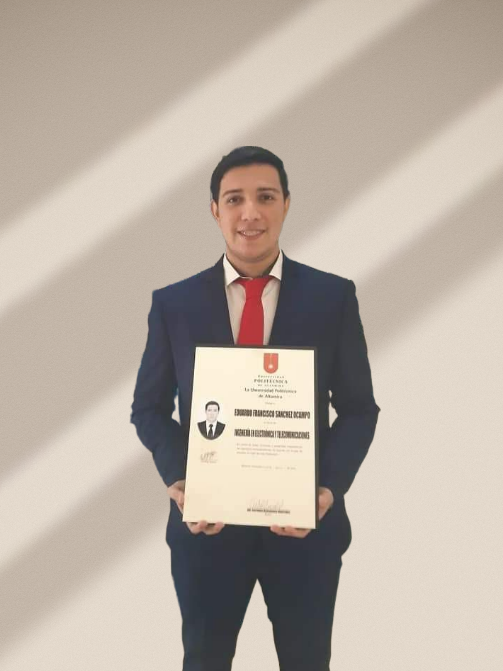
Bachelor of Science in Electronics Engineering
Universidad Politécnica de Altamira
2016-2020
Thesis: Particle Swarm Optimization for Adaptive Control in Chemical Process
-Developed a PID controller for an electrolyzer to regulate hydrogen flow, applying particle swarm optimization for precise parameter tuning.
-Utilized the PIC16F884 microcontroller to integrate hydrogen sensor readings and generate PWM outputs for liquid supply control.
-Applied advanced tuning techniques, including particle swarm optimization, to enhance system adaptability under varying operational conditions.
-Programmed a 2.8-inch TFT touch screen to serve as a human-machine interface (HMI) for real-time monitoring and control of the electrolyzer.
-Designed a closed-loop system using sensor feedback to ensure accurate and stable hydrogen flow regulation.
-Conducted rigorous testing to validate the performance of the PID and adaptive controllers in achieving target flow rates under dynamic conditions.